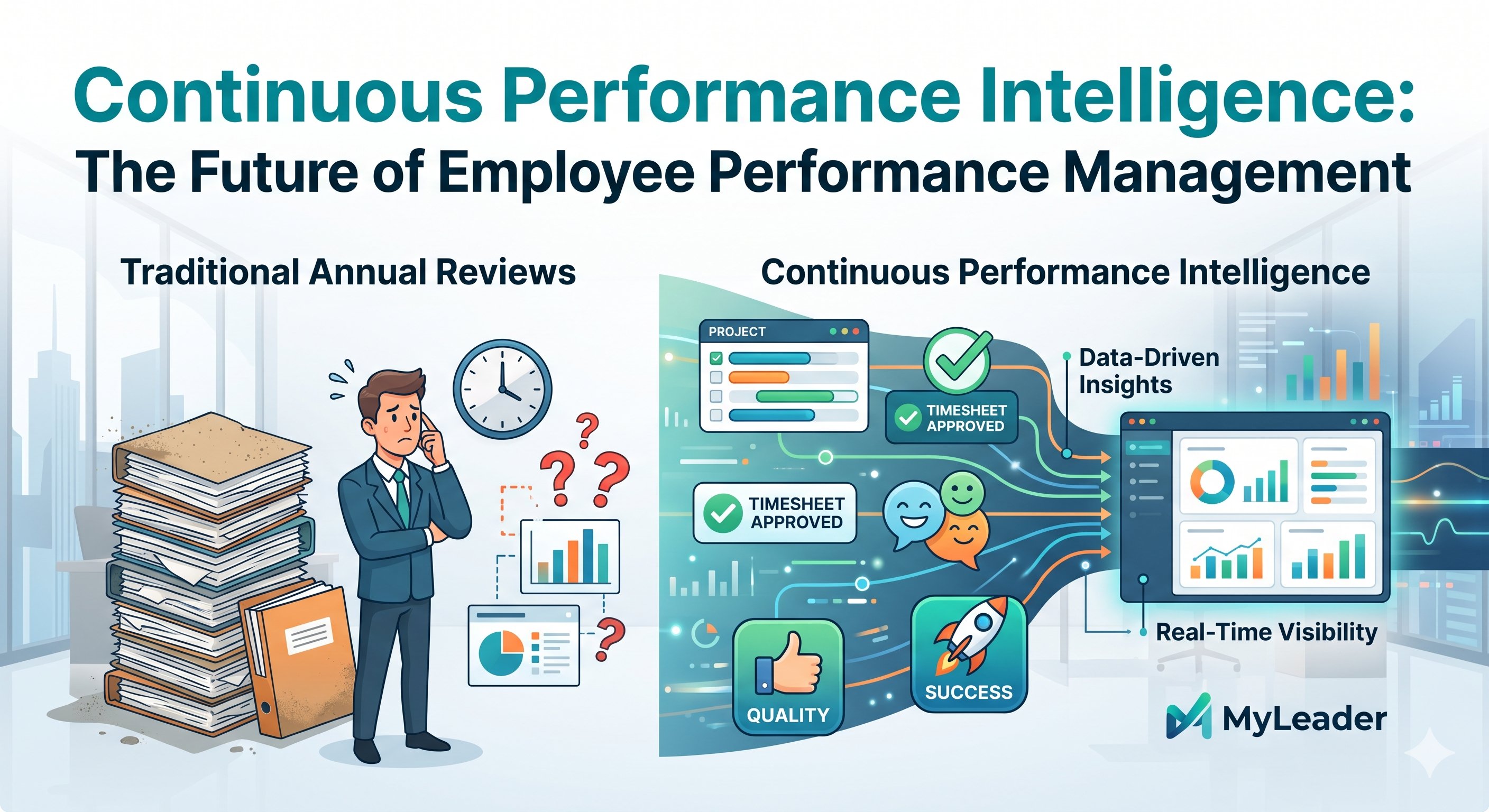
Performance management has changed very little over the past few decades.
Most organizations still depend on annual or semi-annual appraisal cycles where managers evaluate months of employee work in a single review.
While the workplace has evolved with cloud software, real-time collaboration, and digital workflows, performance evaluation often remains a manual and retrospective process.
The result is a system that struggles with subjectivity, delayed feedback, and incomplete information.
A new approach is emerging.
It is called Continuous Performance Intelligence (CPI)—a model where employee performance is captured continuously through everyday work instead of being reconstructed months later.
What Is Continuous Performance Intelligence?
Continuous Performance Intelligence is the practice of collecting meaningful performance data as employees perform their daily work.
Instead of relying on memory, annual discussions, or isolated feedback, organizations build a continuously updated performance history.
Performance becomes an ongoing process rather than a yearly event.
Every completed task, approved timesheet, project contribution, and structured evaluation adds another data point to an employee's performance profile.
This creates a more objective and comprehensive view of contribution over time.
Why Traditional Performance Management Falls Short
Traditional appraisal systems ask managers questions like:
- How did this employee perform this year?
- What were their biggest contributions?
- How consistent were they?
- Where do they need improvement?
Answering these questions accurately months after the work was completed is difficult.
The process often depends on:
- Memory
- Perception
- Scattered notes
- Informal conversations
This leads to:
- Recency bias
- Inconsistent evaluations
- Surprise ratings
- Lengthy appraisal cycles
Organizations need a better source of truth.
Performance Data Already Exists
Most organizations already generate valuable operational data every day.
Employees:
- Complete tasks
- Update projects
- Submit timesheets
- Collaborate with teams
- Deliver milestones
However, this information is rarely connected to performance evaluation.
Instead of treating work data and appraisal data as separate systems, organizations can combine them.
This is the foundation of Continuous Performance Intelligence.
The Five Pillars of Continuous Performance Intelligence
A modern performance intelligence system should capture multiple dimensions of contribution.
1. Work Execution
- What work was completed?
- How consistently were tasks delivered?
2. Productivity
- How much meaningful work was accomplished?
- How efficiently was time used?
3. Quality
- Did the work meet expectations?
- Were revisions required?
- How satisfied were task owners?
4. Collaboration
- How effectively did employees work with others?
- Did they contribute to team success?
5. Continuous Feedback
- What observations were recorded while work was happening?
- Were improvements recognized immediately?
Together, these dimensions provide a much richer picture than an annual rating alone.
Why Continuous Performance Intelligence Benefits Everyone
Employees
Employees receive:
- Greater transparency
- Timely feedback
- Clearer expectations
- Fairer evaluations
Instead of waiting months for answers, they understand how they are performing throughout the year.
Managers
Managers spend less time gathering historical information.
Instead, they make decisions using continuously collected performance data.
This reduces administrative workload and improves appraisal quality.
HR Teams
HR gains access to structured performance intelligence that supports:
- Promotions
- Rewards
- Performance improvement plans
- Workforce planning
Decisions become more consistent and evidence-based.
How MyLeader Enables Continuous Performance Intelligence
MyLeader is designed around this modern approach to performance management.
Instead of treating appraisal as a separate annual activity, MyLeader integrates performance evaluation into everyday work.
Within the platform:
- Managers create projects, assign tasks, and monitor execution.
- Employees log daily work against tasks and submit timesheets.
- Task owners review work, approve timesheets, and provide structured performance ratings and feedback.
Each interaction contributes to a continuously growing performance record.
By the time appraisal season arrives, organizations already have objective performance intelligence built over months of real work.
From Performance Reviews to Performance Intelligence
Traditional systems ask:
"How did the employee perform?"
Continuous Performance Intelligence asks:
"What does the data already tell us?"
This shift changes performance management from opinion-based evaluation to evidence-based decision-making.
It reduces bias, increases transparency, and builds trust across the organization.
The Future of Work Requires Better Performance Systems
As organizations become more digital, employee evaluation must evolve alongside them.
Performance management should no longer rely on annual memory exercises.
Instead, organizations should build systems where performance is:
- Captured continuously
- Measured objectively
- Evaluated transparently
- Analyzed intelligently
Continuous Performance Intelligence provides that foundation.
Adopt Continuous Performance Intelligence
Replace traditional annual appraisals with continuous, data-driven performance evaluation that builds trust, improves transparency, and supports better business decisions.
Book a DemoConclusion
Performance reviews should be the outcome of continuous observation—not the beginning of performance evaluation.
Organizations that capture performance data throughout daily work can reduce bias, improve employee trust, and make better HR decisions.
With MyLeader, businesses can move beyond traditional appraisals and adopt a smarter, data-driven approach to employee performance management.