Most managers want to conduct fair and accurate performance reviews.
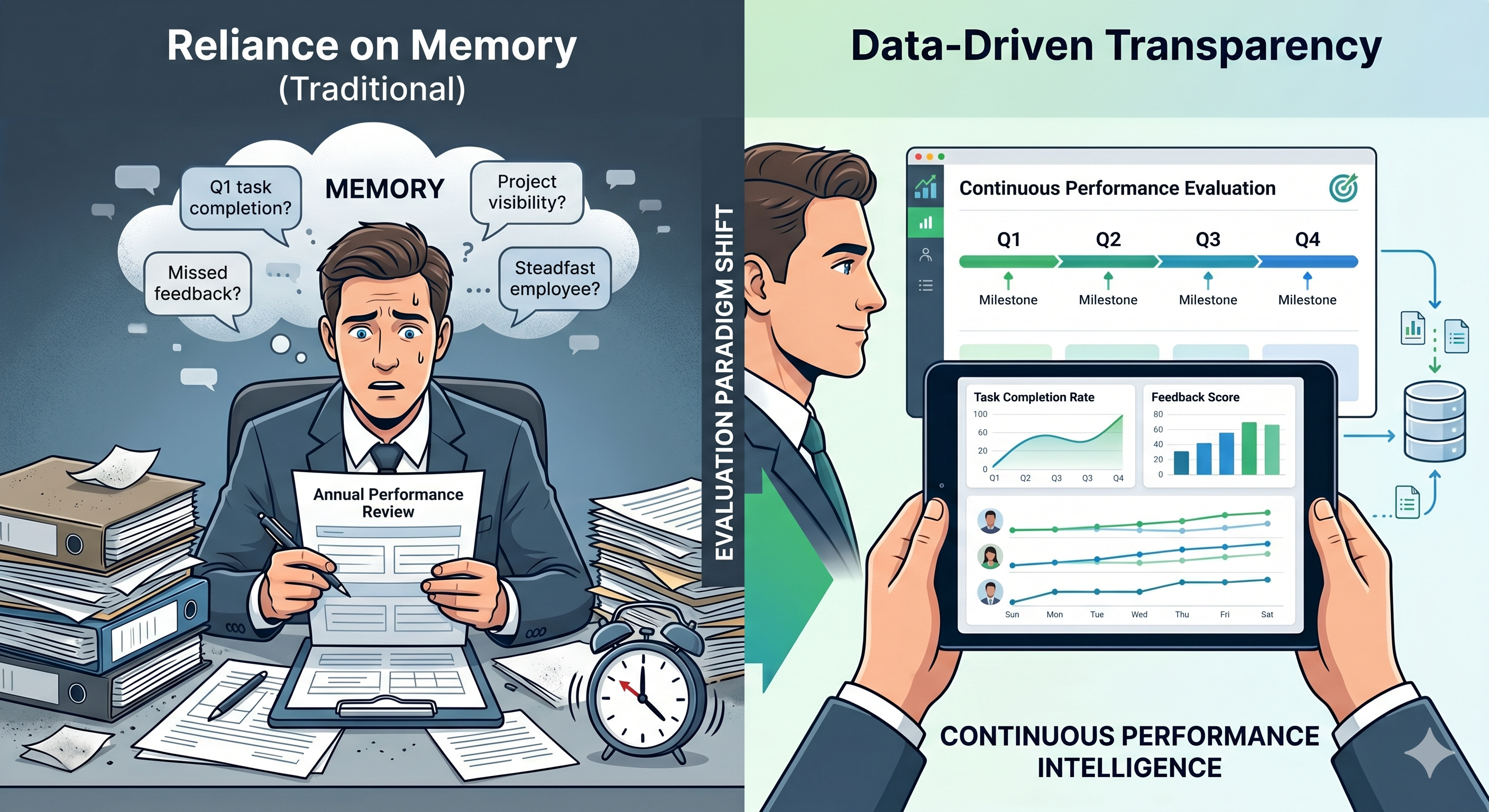
However, fairness becomes difficult when managers are asked to evaluate an employee's contribution across an entire year based on limited information, fragmented feedback, and memory.
The problem is not a lack of intent.
The problem is the process.
Traditional performance appraisal systems place a significant burden on managers by expecting them to reconstruct months of employee performance during review season.
As organizations grow, this challenge becomes even more difficult.
The Impossible Task Managers Face
Consider a manager responsible for:
- 10 team members
- Multiple projects
- Ongoing deliverables
- Client interactions
- Operational responsibilities
At the end of the year, that manager is expected to accurately answer questions such as:
- Who consistently delivered quality work?
- Who contributed beyond expectations?
- Who improved throughout the year?
- Who struggled with execution?
- How did each employee perform across different projects?
Without structured performance data, these answers often rely on memory and perception.
That creates risk.
Human Memory Is Not Designed for Annual Evaluations
People naturally remember:
- Recent events
- Significant successes
- Major failures
- Highly visible contributions
They do not naturally remember:
- Daily task execution
- Consistent performers
- Small but important contributions
- Work completed months earlier
This creates gaps in performance reviews.
Employees who contribute steadily throughout the year may receive less recognition than employees whose work was simply more visible or more recent.
Team Changes Create Additional Challenges
In many organizations:
- Managers change teams
- Employees move between projects
- Team leaders are reassigned
- Organizational structures evolve
When a manager joins midway through the year, they often lack context about earlier contributions.
As a result:
- Historical performance becomes difficult to assess
- Ratings depend on incomplete information
- Appraisal consistency decreases
The system expects managers to evaluate work they may never have directly observed.
Why Employees Lose Trust in Appraisals
When employees believe evaluations are subjective, trust begins to erode.
Common employee concerns include:
- "My work wasn't recognized."
- "Only recent projects were discussed."
- "My manager wasn't involved in earlier assignments."
- "The rating doesn't reflect my overall contribution."
Whether these concerns are accurate or not, perception matters.
A performance review process that feels unfair can negatively affect:
- Engagement
- Morale
- Retention
- Motivation
Employees want transparency and evidence behind performance decisions.
The Hidden Cost of Traditional Appraisal Cycles
Performance reviews are also expensive from an operational perspective.
Managers spend significant time:
- Collecting feedback
- Reviewing historical work
- Comparing employees
- Preparing documentation
- Attending review meetings
HR teams spend weeks coordinating appraisal cycles across the organization.
The larger the workforce, the greater the administrative burden.
This effort is repeated every review cycle.
Continuous Performance Evaluation Changes the Process
Instead of evaluating performance months after work is completed, organizations can capture performance information continuously.
This approach records:
- Task execution
- Contribution quality
- Timesheet activity
- Project involvement
- Structured feedback
While work is happening.
Rather than reconstructing performance history, organizations build it continuously.
This creates a more reliable foundation for appraisals.
How MyLeader.app Supports Objective Performance Evaluation
MyLeader is designed around a simple idea:
Performance should be captured when the work happens.
Within MyLeader.app:
Managers and Team Leaders
- Assign tasks
- Track execution
Employees
- Log daily work against tasks and subtasks
Task Owners
- Review work
- Approve timesheets
- Provide structured performance ratings
Each interaction contributes to a growing performance record.
Instead of depending solely on year-end discussions, organizations gain access to continuously generated performance intelligence.
Better Data Leads to Better Decisions
When organizations capture performance data continuously, they can:
- Reduce appraisal subjectivity
- Improve transparency
- Recognize consistent contributors
- Support fairer evaluations
- Reduce manager workload
Managers spend less time reconstructing history and more time coaching employees.
This creates a healthier performance culture.
The Future of Performance Reviews
The future of performance management is not about replacing managers.
It is about equipping managers with better data.
Organizations need systems that help leaders make informed decisions based on documented contribution rather than memory alone.
Continuous performance evaluation provides that foundation.
As workforce expectations evolve, appraisal systems must evolve as well.
Stop Relying on Memory for Performance Reviews
Discover how MyLeader.app helps organizations build objective, data-driven performance evaluations through continuous performance intelligence.
Book a DemoConclusion
Managers are not the root cause of unfair performance reviews.
The real issue is asking people to evaluate months of work without continuous performance data.
Organizations that want fairer, more objective appraisals need systems that capture contribution throughout the year.
Platforms like MyLeader.app help organizations transform performance management from a periodic exercise into a continuous intelligence process.