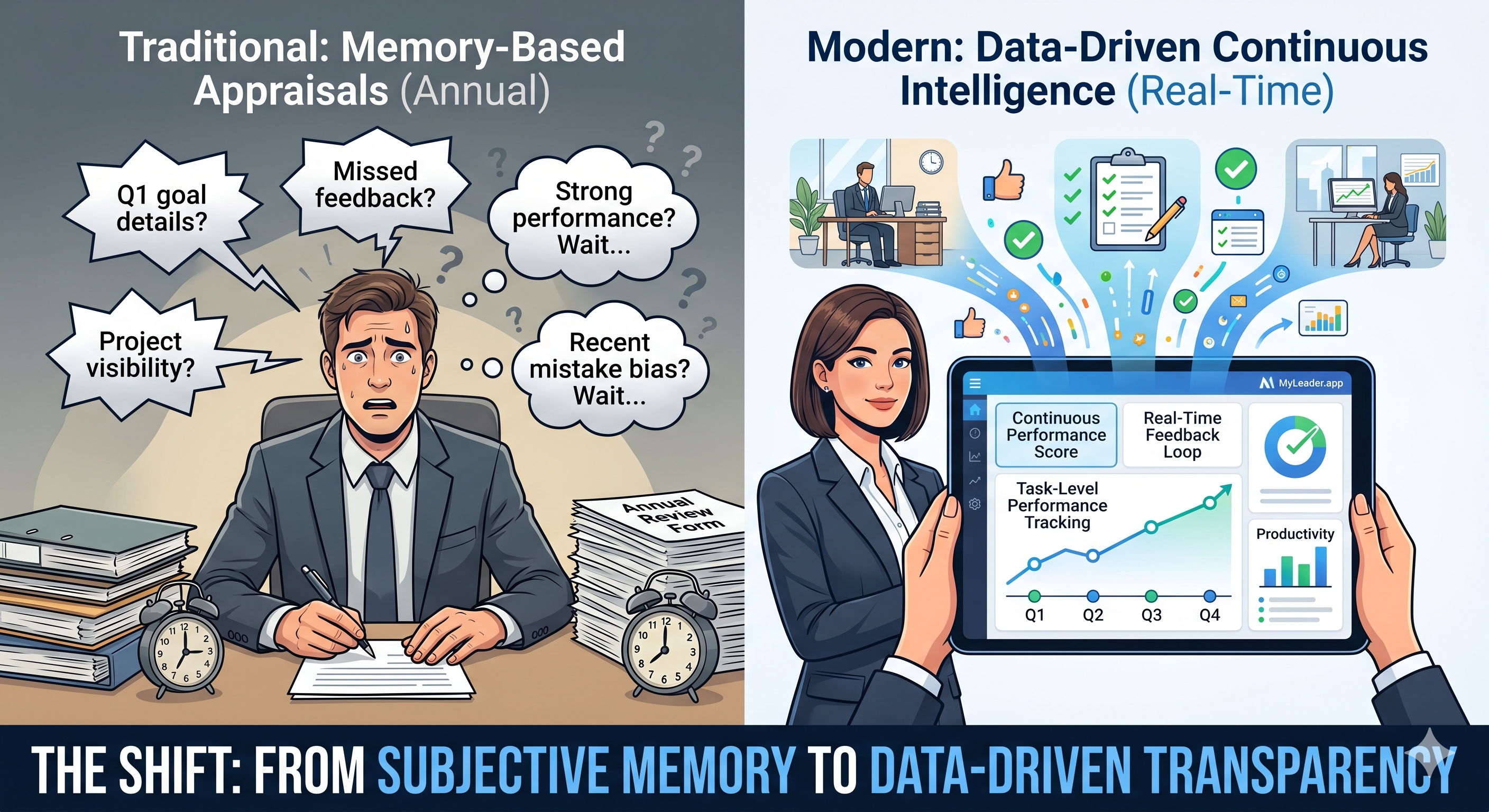
Traditional performance appraisals were designed for a slower, less dynamic work environment. Today’s organizations operate in fast-moving, data-driven systems where annual reviews often fail to reflect real employee contribution.
Most companies still rely on memory-based evaluation, subjective manager judgment, and year-end summaries that attempt to compress 12 months of work into a single discussion.
This creates inconsistency, bias, and frustration across teams.
The Biggest Problem with Annual Performance Reviews
The core issue is simple: performance is evaluated long after the actual work is completed.
This leads to several systemic problems:
- Recency bias influencing final ratings
- Lack of continuous feedback loops
- Dependence on subjective manager memory
- No structured historical performance record
- Time-consuming appraisal cycles
As a result, employees who consistently perform well throughout the year may still receive inaccurate ratings.
Why Recency Bias Damages Fairness
Recency bias occurs when recent events influence evaluation more than overall performance history.
For example:
- A strong employee may get a lower rating due to a recent mistake
- A weaker performer may get a higher rating due to recent improvement
This imbalance reduces trust in the system and creates frustration among employees who expect fair, holistic evaluation.
Managers Are Overloaded During Appraisal Cycles
Annual review cycles also create significant operational burden for managers and HR teams.
They often spend time:
- Reviewing past work across multiple months
- Collecting feedback from different stakeholders
- Validating timesheets and project records
- Writing structured appraisal reports
This becomes even more complex in distributed teams and long-term projects where contributions are fragmented.
The Shift Toward Continuous Performance Evaluation
Modern organizations are moving toward continuous performance management systems.
Instead of waiting for annual reviews, performance is captured in real time during day-to-day work execution.
This includes:
- Task-level performance tracking
- Real-time feedback loops
- Timesheet-linked evaluation
- Continuous contribution recording
This approach ensures performance data is always current, accurate, and context-aware.
How MyLeader.app Solves This Problem
MyLeader transforms performance evaluation into a continuous operational process.
Instead of relying only on end-of-year reviews, it integrates evaluation directly into daily workflows:
- Managers assign and track tasks
- Employees log daily timesheets linked to work
- Task owners review execution in real time
- Structured feedback is captured continuously
This creates a live performance dataset based on actual work activity rather than memory.
From Project Management to Performance Intelligence
Unlike traditional tools that only track tasks and timelines, modern systems like MyLeader extend into performance intelligence.
This includes:
- Task-level performance evaluation
- Workforce productivity insights
- Absence and impact analysis
- Continuous appraisal data generation
This allows organizations to automatically build performance history through everyday work.
Business Impact of Continuous Tracking
Organizations adopting continuous evaluation see major improvements:
- Reduced appraisal workload
- Higher transparency in performance
- Faster HR decision-making
- Lower bias in evaluations
- Better workforce accountability
Instead of reconstructing employee performance once a year, companies already have structured data ready.
See Continuous Performance Tracking in Action
Learn how MyLeader.app helps organizations move from subjective annual reviews to real-time performance intelligence.
Explore MyLeader.appFinal Thoughts
Annual appraisals belong to a different era of work. Modern organizations need continuous, data-driven, and transparent evaluation systems.
Continuous performance evaluation improves fairness, reduces bias, and creates a more accurate understanding of employee contribution over time.